“Snow is so beautiful. So romantic, too. If I had a choice, I’d want to be proposed to in either snow or rain.” – Nik Gallicchio, January 14, 1998

In 1998, a silly girl wishes for rain

when her inevitably broad-shouldered, blue-eyed, simply-last-named suitor proposes.

16 years later, after a treasure hunt of clues

hidden where they first met, danced, and kissed,

the rain courses over her umbrella path to the last stop—

where he’s been waiting for her all night long, all life long—

the porch, lit up by fireflies and anticipation.

The waterfall of diamonds from the sky two-steps on the roof.

Hair sticking to her face, heels slipping on her wet feet,

she doesn’t realize the forgotten wish is coming true.

She doesn’t notice his blue eyes or broad shoulders;

Instead, she sees a man who spends four hours hand-making her birthday card,

who hand-binds her novel, stitch by stitch,

who reads fairytales as she drifts off to sleep.

A clink later, they drink the stars.

The wishes she wasn’t smart enough to wish

meet her gaze and offer their hands

She says yes and holds on tight.

The POEM-A-DAY June Challenge is here! Thank you, Sandra Beasley, for inspiring this month-long poetry bonanza!

wishing

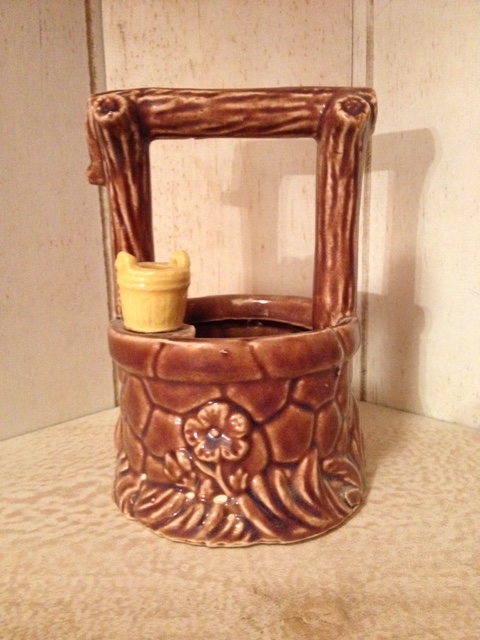
You were you, I was the wishing well

With the little yellow bucket that’s sat on my lip since the 70s,

A hopeful sun against the gnome brown flowers.

You kept me next to you while you worked,

Stuffed me with pens that held promises in their inky veins.

I granted that wish about you having a little boy first, followed by a little girl.

And that one about your mother knowing your children before she forgot herself.

You saved me alongside newspapers, books, junk mail,

And I saw that little girl drowning, drowning in the maelstrom.

There was a wish you didn’t know needed wishing

When the little girl wished to open her veins to paint herself in red ink,

And I had to swallow my bucket to draw out a wriggling, breathless reason to live.

She never knew. Neither did you.

And now you’re gone.

You will never know her children.

And she—the hoarder’s daughter—she’s giving me away.

And her children won’t know me either.

Oh, Memoir? He’s a bit of a dick.

This is what happens when writers go head to head in battle for their beloved genres–

Outscarring

The poem bites its fingernails—so small, so quick.

The story steadies its breath.

The novel catches itself in the mirror and sits up straighter, peacock-chested,

And the memoir rolls its eyes.

They sit around a table clouded by coffee-scented smoke.

The novel clears its throat and brags, “I’ve got a fatal car accident. How about you?”

Memoir waits for Novel to meet its eyes, rolls them again

so Novel knows, for Chrissake,  and replies, “I don’t believe you.”

Poem’s eyes dart back and forth between them.

Story says, “I’m holding a brother’s paralysis.”

Memoir raises its eyebrows. “Too bad that won’t trump a mother’s death.”

Memoir stares and Story looks away first.

Poem’s fingertips muffle its words.

“Speak up!” the rest chorus.

Poem’s mouth speaks, a quiet graveyard of headstone teeth: “A child dies.”

And no one knows how something so small can break for so long.

Standing in front of a class feeling naked and having it NOT just be a nightmare? Check.

I was strutting down the school hallways when a colleague complimented my trippy-print, flower-power skirt. “Thanks! It’s vintage.” I’d cut off the scoop neck of the dress and had sewn a zipper in it to make a long, flowing skirt with a knee-high slit up the back.

Within the first few minutes of my first class period, my juniors were busily typing away to fulfill the task due at the end of the period.  A student waved me over, and I sat down in the desk next to her to answer her question.

And that was the moment I felt it. That harrowing moment when you know your butt is touching something it shouldn’t.

“What? Yeah, your thesis looks fine. Great.” I ran my hand down the back of my skirt, as though smoothing it out as I re-adjusted in my seat. Sure enough. Definite side-butt flesh-on-chair contact. Had the students noticed and not said anything before I sat down? When did it rip? Had an errant breeze given these 17-year-olds a glimpse of my “I Heart Paris” underwear? No. There’s no way they’d be mature enough to keep it together. But the hole was huge. It was like the slit didn’t stop at the knees anymore and just….yup, went all the way up.

Turns out, vintage threads…are old.

“Yup. Looks good,” I said, standing up. Yup, it’s totally normal to have a death-grip on the back of your skirt, darlings. They were all engrossed in their laptops. Thank god for attentions spans satiated only by glowing screens! I nonchalantly walked out of the room and booked it to the nurse’s office.

I burst through the door, frantically shouting, “Sewing kit!”

The secretary paused her typing at the front desk. A student with an ice-pack on his eye shifted it to the other eye, glancing from his sickbed to where I stood. The nurse nodded and retrieved my deliverance.

Her eyes gave me a once-over as she held the kit hostage in her hands. “Where—“

“A very unfortunate place. Is there an empty room I could use?”

She smirked, but handed over the kit wordlessly and ushered me to a room.

The safety pins offered iron-clad comfort, but they still left gaping inch-big holes for the spaces in between. There was only one way. My hands shook, so it took me awhile to thread the needle. The thought: “Hurry, get back to class!” battled with: “You’re a lady, for goodness sake!”

The thread from the 70s practically disintegrated beneath my hasty seamstressing. This wardrobe malfunction had wiped away any smugness about being proud of skirt-updating skills. I sewed with the speed of hallway gossip about the quiz next period. A bit slipshod, but it would get me through the day. I headed back to face the juniors.

Oh, them? They were all still typing away, as though nothing had happened.

The smooth face of a plate

You bought the Easter egg-shaped plates several seasons ago. Their edges are scalloped, like crenellations of a little happy castle. You discover today that your husband has chipped them. Accidentally, of course. Two of the four. The set is ruined. You lay next to him as you try to fall asleep, his syncopated snores chipping away at your chances of a decent amount of sleep.

You discover this after you both get back from his follow-up heart surgery check-up. You can still hear the doctor tell you that his artery had been 90% blocked—thank god you caught it before it caused a heart attack. After the stints, all he’ll need is exercise—look how the blood flows so smoothly now.

And you know how, if the news had been bad, if you hadn’t caught it in time, you would’ve come home to your quiet house and unleashed shrieks like ice picks, grabbed the pristine plates, and hurled them against the wall, and felt that the shards weren’t jagged enough, weren’t nearly jagged enough.

Twitchy sleep with dangerous edges

My worry springs from this:

The countless children whose pop tart voices ask daily if we’re watching a movie during the class period. They crunch their Cheetos to the rhythm of their heartbeats. They want to stare and imbibe every period of the school day for seven hours and then go home to binge-watch more while munching on Wendy’s.

The worry is this: that there is little time spent actively thinking, creating, doing.

The food they eat has been processed and packaged by someone else.

The shows they watch have been conceived and created by someone else.

The dreams they dream in their twitchy sleep will have been birthed by someone else.

These children take everything in and give out no energy for game-inventing or story-creating or deliciously fresh dinner-making.

When the most active task done during an irreplaceable day is bemoaning your schoolwork fate on an update or post, complaining about being encouraged to surf along the waves of your brain instead of the web, when will you see how others are living your life for you? You’re not living. Somewhere alone the line, you let go of the steering wheel, and your life crashed into a twisted pop can gnarled with dangerous edges, but your eyes are on the wheels, still spinning uselessly, and they trick you into thinking that you’re still moving, that you’re on the right track. You aren’t.

But you’re not alone.

It’s a hard life, to think and create and do. It’s so, so much easier to sit and watch. Believe me, I know. For five months now, I’ve been dreaming up a plan for a book page dress. Three months ago, I bought a dress to use as the sheath that I’d glue all the book pages to. Two months ago, I bought a snazzy paper punch that makes pages look like lace. One month ago, I picked out books whose pages were thick enough to use. This past weekend, I finally started the project in earnest. I’d put it off for so long because I didn’t want to get it wrong. It was only when I assured myself that whatever I did was a rough draft—that whatever I pasted on the dress didn’t matter—that I was able to actually start assembling the damn thing.

I want to believe that the people I surround myself daily with genuinely want to create something of value. But does insecurity secure their inaction? When will they harness their power? Every single day is a challenge to wrench back the wheel, shift into overdrive, punch the gas, and go, go go.

The first sign of Spring is hanging out with a bunch of old, white, Republican men.

H’okay. I’m gonna try to say this in the least meathead way possible:

……To me, Spring equals MARCH MADNESS.

In February, I don’t start bracketizing every aspect in my life or bet on which player will sustain the most gruesome injury that makes even the nearest bird mascot hide his eyes under his wings.

March Madness is only significant to me for one night—the last one. The final game. Because that means I’m hanging out with a bunch of old white Republican men.

Every year, my dad and his buddies get together to watch the game. A judge, an electrician, a retired guy, and my dad the accountant were there last year. Two of them made a $1 bet on the game, then trash talked the whole time about the fate of that dollar. That’s pretty much how the whole night goes–

Retired guy says, “I been drinkin’ the low calorie beer now. It’s not too bad.”

Electrician glances at him, [looks him up and down] “Yeah? You ain’t drinkin’ enough of it.”

The judge has been divorced three times and because of this expertise, presides over family court divorce proceedings. He says, “Then the lawyer approaches the bench and he says, ‘Judge, this is an elderly couple, you know how they drag it out sometimes’ and I look at the documentation and I see that the husband is a month younger than me! So I say to the lawyer, ‘Did you say ELDERLY?’ And he realizes and says, ‘Oh no, judge, I just meant there were no dependent minors to worry about, that’s all. That’s all!’”

Someone pipes up– “So I’m guessin’ he didn’t win the case.”

Every man in the room has been divorced but my father. The topic of ex-wives always pops up sooner or later.

Retired guy says, “Bonnie still doesn’t drive. She doesn’t leave the house! Pays a neighbor kid to get the mail for her. Long time ago when we needed to meet up at school for the kids, I told her I’d call her a cab. She said, ‘No! It might be a foreign man and he might want to have sex with me!’ I told her, ‘You should be so lucky.’”

I KNOW they’re even more crude when I’m not around.

Dad points to the judge and says to me, “Listen to what he does every Sunday for his parents. Just listen!”

Judge says, “I make them breakfast. Eggs, sausage, toast, bacon.”

“AH?! AH?! What a good kid! So whaddaya wanna do for ME on Sunday?”

Before I can answer, Judge says, “Well, I didn’t start doing it until they were both 90 years old.”

“Oh, you ruined it! Why’d you ruin it?!”

I tell dad I’d be happy to make him breakfast every Sunday once he makes it to 90.

Two of the men here have gotten remarried. The judge has no trouble finding girlfriends–he looks like Richard Gere and dances like a 30-year-old.

My dad is the only one of them who goes home to an empty house every night.

Usually, we watch the game at the Insurance Agent’s house, but his wife’s cancer is back, so he’s with her tonight instead. The doctors can’t help much this time. She’s getting weaker. The last time I saw her, her backbone traced a line of silk bumps under her blouse.

This is a story Dad and I know well. The doctors couldn’t help much with my mom, either.

These men have known each other for more than forty years.

They know the whole trajectory: from single bachelor to married man, to father, and in my dad’s case, to widower. And in other cases, to divorced, to remarried, to divorced, to remarried, to divorced again.

This night is a yearly springtime tradition for them.

My weekly tradition with my dad is breakfast every Friday at 6 a.m. I don’t cook it for him, though—we meet at a local diner.

And every Friday at 6:53, when we’d be leaving, Gary, who my dad knows because of Rotary Club, would walk into the diner.

We’d say hi, chat for a bit about the weather or he’d give my dad a hard time about tax season.

Gary was a 91-year-old widower. Ever since his wife passed away, he’d gone out to restaurants because she’d cooked him every meal. This, too, is a story my dad knows well.

One Friday morning, Gary didn’t walk in at 6:53. He had passed away.

I feel his empty table absence on Fridays, and I wonder on this March Madness final night, if all these men who surround me watching the game will eventually surround themselves with restaurants full of people because they don’t want to enter the kitchen and interrupt the memory of their wives bustling around in there; if they’ll go out so they won’t have to listen to the clock tick inside an empty house. Or that one day, one of them will wake up from a nap on the recliner, still half-dreaming of the smell of something good cooking, something familiar and warm.

I’m not afraid of Virginia Woolf–so much so that I emulate her

She was scheduled to stay late tonight for line-by-line grammar edits of the school newspaper. She didn’t like grammar but respected it, as though it were a gruff uncle who’d fought in the war and didn’t smile but showed up every holiday with a casserole. Grammar could be counted on for casserole. Perhaps green bean-based, something you’d feel obligated to spoon onto your plate at the gathering, and Gruff Uncle would nod, all is in order, all is in order.

Her eyes veered to the window. Dead leaves clung to branches on a maple tree.  An evergreen stood as narrow and tall as it could, as though trying not to be noticed. She didn’t want to look at the greyish-white house with its black shutters and drab concrete stairs. She wanted to look at its green door. It was a green of mythic proportions, inspiring visions of dragons’ scales or mermaid tails. That a door that green could exist amidst the tramped-on slush January held the promise of hope in its keyhole.

The fact was, the girl was out of spinach, and had cursed herself this morning for neglecting to purchase some over the weekend. Now, the week was off to a running start and she was choking on its dust because there would be no healthy breakfast tomorrow without it, and she really should have a healthy breakfast in light of the unfortunate-yet-delicious cupcake frenzy last week.

She’d been faithfully blending spinach smoothies in the morning for months now, but she wouldn’t want to stop on the way home in the 9pm dark, not in the icy cold, not a detour from the most efficient route to her bed from which she must rise again bleary-eyed in too-few hours.

She’d mentioned this spinach conundrum to her fiancée in the morning when he mentioned he needed to get yogurt, and thought of it again in the evening when he’d brought her hot cocoa in the newspaper room. They’d sat and dreamed up Valentine’s Day plans for this year as she took a break from the Gruff Uncle Grammar’s grim sighs.

He’d worn the hat that she despised, with its blue braids drooping on either side, begging her to rent them asunder. But he’d brought her hot cocoa, and its sweetness must quell her fantasies of hat-sabotage.

She suggested, “What if you and I each surprise each other with a sweet ingredient and then we make up a dessert recipe that uses both?”

They both sipped on their respective hot cocoas and she thought of Sedona, Arizona two Christmases ago where they’d learned of an Indian wedding tradition of having the bride and groom drink from different sides of a two-spouted vase and how even though they were drinking from different cups, the same cocoa warmed them up. When he tasted it, did the cocoa taste the same as it did to her? Were two people ever able to share an experience? She wanted to point to the green door, “Do you see it? Do you see it?”

But she didn’t.

He approved of the mystery dessert plan and left her to dutifully follow grammar’s orders.

The night drifted on and the snow and the dark blotted out the green door when she exited the building she’d entered more than thirteen hours earlier.

If it wasn’t so icy, she thought, she wouldn’t be so angry about having to stop for spinach. Or maybe if it wasn’t spinach, the ugly child of the Gruff Uncle who knew what was best, who never let you forget it—the bossy cousin who you were forced to play with, who always decided what game to play and that you were going to be the sidekick. That was the problem: spinach made one feel like a sidekick.

In light of its perfection, you were inferior. Unhealthy. Riddled with excess and waste unlike the spare and majestic green-leafed wonder with nature stamped in every chlorophyll-ed vein.

If only she hadn’t needed to glovelessly scrape ice from her windows while the moisture pervaded her thin-soled boots. She thought, would rather he had scraped the windows than brought hot cocoa. She was ungrateful. She was petty. She was undeserving of hot cocoa. She thought of a friend’s sister who, when she’d had two men courting her and she’d come down with a cold, one brought her soup and one flowers, and the question to be answered was: “Which do you want for the rest of your life?” The sister had married the soup. They had three girls and one round-faced boy now.

She finished the ice scraping and would’ve definitely married the soup, too.

She drove home carefully, not wanting to deviate from the black tracks of previous tires on the snow and ice-encrusted streets. No way was she veering from the route home. The spinach would have to wait. She felt its disapproving crossed arms, its sanctimonious close-eyed shake of the head from the grocery store two blocks away.

When she arrived home, she peeled off her wet boots and opened the door of the refrigerator to contemplate next morning’s breakfast.

And there it was, green and glorious.

The beautiful man had bought her spinach.

She closed the door and knew the fairytale secret locked in its keyhole. Her whole being whirled with dizzy giddiness enough to stay up all night and start their once upon a time every time to live forever in the light of the moon that illuminated each snowflake that was different, like how this moment was different from each of their five years together and would be different from all the years to come, and it was that the spinach affirmed something she didn’t realize needed affirming. She knew. She knew. This was the beautiful man she would marry.

What was saved

My mom saved packaging. The UPCs from her endless packs of Salem cigarettes, the woven red cages that once held oranges. The coleslaw and potato salad containers that stacked up until we couldn’t see each other anymore. Until there was no way to get around it. Until any move would topple the fragile house she’d built.

She hoarded information. Magazine articles, recipe cards, newspaper clippings, and books upon books upon books. She took notes on the news, on radio shows, on conversations she had. Last Tuesday, I found a slip of paper where she’d documented each of our reactions to the movie “The King’s Speech.” On Christmas Eve 2008, my dad didn’t say ‘Happy Birthday’ to her until the evening, when he arrived home from work. Did she keep track of all of our sins, our transgressions, our rude comments? Where did she file rolled eyes? We were rats impatient in the maze built of stacks of knowledge, and there was never a way out.

The day I got kicked out of the house, I’d held high a stack of papers in the bathroom, threatening to throw them on the ground.

“Put those down,” mom demanded. My dad stood, silent, behind her.

I had a flair for the dramatic back then. I bargained. “Admit this stuff is more important to you than we are.”

“Put it down,” she said again.

To me, that was her admitting it.

I threw down the handfuls of carefully tracked numbers, the thoughtfully saved news clippings all over the bathroom tile.

“Get out of my house,” she said. Dad didn’t argue. Neither did I.

I nosed my way out of the maze, rat eyes blinking in the sun.

It’s been nearly four years since she died, and I’m still finding notes about a ruby inset necklace that would make a nice 21st birthday present for me. A script of ‘how are you?’ and ‘what have the kids been up to?’ that she wrote out in preparation of corresponding with an old high school friend. She felt she needed a script.

If I puzzle-fit her notes, can I cobble together what I wished our mother-daughter talks could have been? Will her encrypted messages feel like a kiss on my forehead?

I’m unbuilding her, page by page, giving away everything it took her a lifetime to save.

Addict of first kisses

At a trendy Chicago restaurant that specializes in exposed brick and suggestive lighting, I play wingman so my friend can coax a job from a conversation with the Chilean Consulate.

We are there because the brother of her Chilean cousin-in-law was unveiling his artwork that night. The large artwork hangs brazenly across all the tall walls, a testament to his career as a painter—the more recent years of which had been affected by his diminishing eyesight due to a degenerative disease.

My friend’s cousin says, “When he tells me on the phone, ‘it is getting darker now, so I’m done painting,’ I didn’t realize it was because he couldn’t see the colors anymore.”

We see the influence of blindness. His early paintings are two-dimensional black-and-white endeavors: a shoelace untied, a bare foot kicking through a wall, and the question: ‘Who are you?’ His later paintings are wordless carousels of color so thick that it can be gripped by fingertips, the rough serrations of a knife dragged through paint to leave a handful of strict parallel lines. Each painting is an unexpected adventure.

I chat with the companion of the Chilean consulate while my friend’s tongue wrestles with the Spanish she knows to communicate how much she’d love a job under him.

When I introduce myself to the companion amidst the symphony of Spanish words, I’m relieved to hear him say, “Hi. I’m Alexander,” and go on to tell me he’s from New Jersey. I can feel my smile widen.

He moved to Chicago last Thursday. “People say ‘excuse me’ and ‘please,’” he says. “I’m not used to that.”

He’s dark-haired, pale skinned, Chilean on his mother’s side. His grandpa was French. His laugh sounds like a stone skipping on water.

He glances over my engagement ring as our stream of conversation flows uninterrupted.

I was that single girl for so long, searching for my next adventure, an addict of first kisses, that comes as a surprise to me that I’m not anymore.

He’s an only child. I bet his mother misses him.

“Yeah, she helped me move in, stayed with me to set up the apartment for a few days.” My mind flashes to a blind date eight years ago with a divorce lawyer, 35 years old, living at home with his mom still folding his laundry. Red flag. Red flag.

But there’s no need for red flags anymore. I will never see Alexander again.

I will think of this night and his laugh when I step onto the black sand beaches in Santiago that he tells me I have to visit someday.

But tonight, I want to dive into his eyes to see myself as irreplaceable and ephemeral in a bright carousel of colors that his eyes have never alighted upon before. I don’t want that vision to dim slowly, inevitably, until I can’t be seen anymore. Until it’s as if I’m not even there. Until there are no more unexpected adventures.